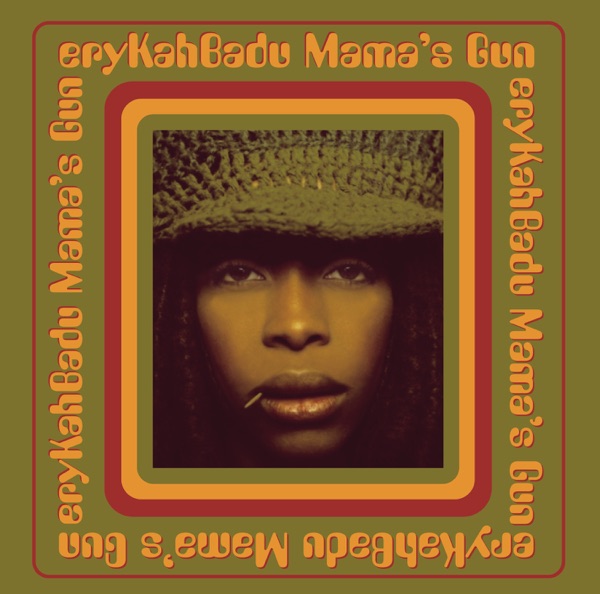
Erykah Badu
Mama's Gun
For her second studio album, Erykah Badu widened the space around her voice. Live-band interplay, hip-hop production and unusually direct writing turn Mama's Gun into an exploration of self-worth, love and loss, with its intimate moments sharing room with urgent social reflection.
Album essentials
- U.S. release
- 21 November 2000 1
- Key producers
- Erykah Badu, James Poyser, Questlove and Jay Dee (J Dilla), among others 4
- Notable singles
- Bag Lady; Didn't Cha Know?; Cleva 4
- Principal recording location
- Electric Lady Studios, New York; Badu also recorded in other locations 3
- Key players
- Questlove on drums, Pino Palladino on bass and James Poyser on keyboards; Badu contributed guitar and percussion 3
Making room for a different Badu
Baduizm had established Erykah Badu in the late-1990s soul landscape. Mama's Gun broadened the picture. Its writing addressed self-doubt, relationships and social concerns more directly, while its arrangements pushed into funk and jazz. It belongs to the same collaborative period that produced D'Angelo's Voodoo, while retaining a character very much its own. 2
The opening Penitentiary Philosophy makes that expansion immediately apparent: its forceful live-band sound unsettles any expectation of simply repeating the debut's atmosphere. At the opposite end of the record, Green Eyes becomes an extended account of a relationship coming apart. Those bookends suggest the album's range before individual favourite tracks even enter the conversation. 1
Songs formed while the band played
Speaking to Mark Ronson for The FADER, Badu recalled making most of the album at Electric Lady with musicians together in one room. Questlove played drums, Pino Palladino bass and James Poyser keys, while she contributed guitar and percussion. She described the writing as spontaneous, developing as the sessions progressed. The ensemble was part of the composition process, not merely a set of players brought in to decorate completed songs. 3
She was equally attentive to the journey between tracks. In that same interview, Badu remembered changing the sequence after the packaging assets had already been delivered. She supplied a note for the label to insert and asked for the printed order to be corrected on the next pressing. It is a revealing behind-the-scenes detail: the way listeners moved through the finished album mattered enough for her to revise it at the last moment. 3
From private feelings to a wider world
The album's musical resources include both live performance and hip-hop craft. Jay Dee, better known as J Dilla, contributed to Didn't Cha Know?, My Life and Kiss Me on My Neck. That combination makes Mama's Gun a useful reminder that the era's organic soul sound did not require abandoning sample-based imagination. The production credits represent overlapping approaches, brought together around Badu's writing and delivery. 4
Bag Lady provided a prominent single, while A.D. 2000 responded to the killing of Amadou Diallo. Elsewhere, Stephen Marley joins Badu on In Love With You, and Green Eyes gives emotional uncertainty the room of a multipart closing statement. These shifts are central to the album's character: personal pain, affection and concern for the wider world belong in the same conversation. Mama's Gun leaves space for all three, without requiring Badu to present one fixed version of herself. 2
Sources & reading
- Apple Music — Mama's Gun notes and U.S. release information
- Recording Academy — Didn't Cha Know?: Twenty Years of Mama's Gun
- The FADER — Erykah Badu discusses making Mama's Gun with Mark Ronson
- Wikipedia — album credits, singles and recording reference
Essentials describe the original album release. Artwork and listening links may show a later edition; they do not identify Wayne’s own CD pressing.
Researched feature · Updated


